
Maternal health equity is an urgent challenge that can be solved

Maternal health equity is an urgent challenge that can be solved

Worldwide, we are losing ground on maternal health outcomes. 

Maternal deaths are rising in many parts of the world, and we are not on track to meet SDG 3.1: Reduce the global maternal mortality ratio (MMR) to less than 70 per 100 000 live births by 2030. In February 2023, the WHO released a report indicating that nearly 800 women died every day in 2020 – about one woman every two minutes. 

More importantly, maternal deaths are not distributed equally. On a global scale, most maternal mortality is concentrated in sub-Saharan Africa (69%), particularly West Africa. Pregnancy-related causes are still the leading cause of death among African women aged 15-29. In the US, black women are 2.6 times more likely to die due to childbirth than white women. 

This significant equity challenge is being overlooked; the deaths of mothers deserve more attention and more resources. Within Mali, even though pregnancy is deadlier than armed conflict, the world pays far more attention to military action than the deaths of pregnant women.

At the same time, nearly every maternal death could be prevented. Though there is no standardized global data, studies from sub-Saharan Africa routinely show that over 90% of the causes of maternal deaths could be avoided with access to basic, quality maternal healthcare. In the US, more than 80% of maternal deaths could be avoided.

This contradiction is important and revealing – maternal mortality is mostly preventable, but we are still failing to prevent it. African women, and black women in the US, are dying at significantly higher rates. We must confront this truth, and its origins. We know what interventions work to improve maternal health outcomes. Our focus must stay on why all women and all communities don’t have access to them, and fix it.

Our current systems, strategies, institutions, and financing are not reaching the women most in need, because the women most in need are not represented in our current systems, strategies, institutions, and financing. In our current approaches, marginalized women and communities are usually rendered as passive recipients of services, not as actors with agency who are essential participants in the development of remedies to these deep and historic inequities.

To fix this problem, as Dr. Mary-Ann Etiebet noted, it is not just about what we do. It is about how we do it. We will not fix it by continuing to use the same approaches that have created and are maintaining these gaps in maternal health equity. It won’t be solved from the top-down, which is still how most of the world’s global public health systems work. What’s required is not developing a new technology or innovation.

If we are going to stop and reverse the increasing trend in maternal mortality, the women and the communities most affected must be at the heart of solutions.

If we do not change our approach, the result would be disastrous. By one estimate, if the reduction of maternal deaths continues at its current rate, SDG 3.1 would not be met in the African Region until 2100, after 125 million mothers died from a cause related to childbirth.

So what does it mean to change the how of our sector? What would it mean to dismantle entrenched systems designed to retain power and decision-making in certain hands? How do we prioritize and center the voices, experiences, and knowledge of those whose needs are not being met?

Instead of continuing to operate through our existing institutions and structures, and building interventions around their capacity to deliver or distribute solutions to a population, it means turning our focus to the mother who needs access to those solutions and starting to address the problem from her perspective.

 It requires a complete shift towards a more fundamental question of who is invited to participate in the solving – who is invited to participate in the how.  It means being willing to give up control and to pursue solutions that put power and resources into local hands.

We are trying to put this shift into practice every day. Whether it is adapting traditional quality improvement processes so they can be led by local teams of women and stakeholders, or redefining local health financing to ensure that women have the ability to build and manage their own health-financing resources, we strive to use a women-centered approach in every strategy. We convene and support women, community members, and providers in the community health system to work together to identify and solve obstacles to quality maternal healthcare in their communities.

Ending preventable maternal mortality is a problem that can be solved, but only if we’re willing to change how we try to solve it.
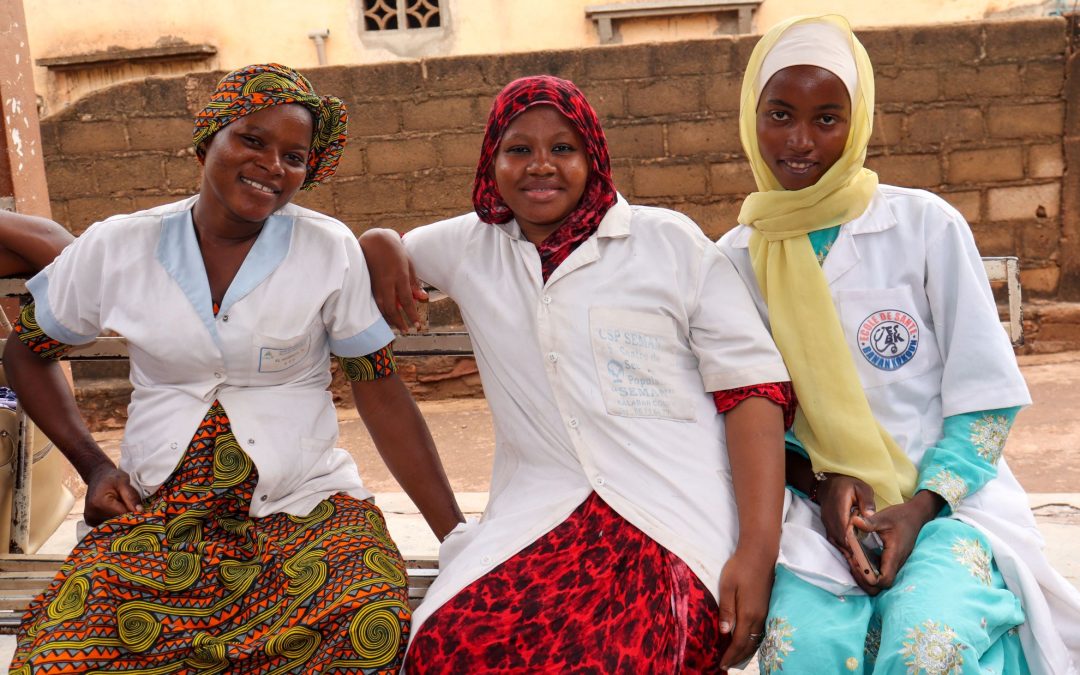
Investing in health workers, from the ground up

Investing in health workers, from the ground up

Led by the Frontline Health Workers Coalition and partners, World Health Worker Week (WHWW) brings together advocates, health workers, leaders, and communities calling for more resources to support health workers.

Directed primarily at policymakers and global leaders, the goal of this week is to urge decisionmakers to follow through on global commitments and to invest in, protect, and support the health workforce, especially women.  The 2024 theme is Safe and Supported: Invest in Health Workers.

The case for investing in community health workers is clear and proven, with immense health, social, and economic returns. Though the financial return on investment for the primary health care workforce has been demonstrated to be as high as 10:1, the current funding gap for community health programs is estimated to be $5.4 billion annually.

Across the African continent, there are many contexts in which leaders and decisionmakers have made policy commitments related to investing in health, but have not yet implemented them.  In 2001, African Union countries set a target of allocating at least 15% of their annual national budgets to their health sectors, known as the Abuja Declaration. But achieving this goal has remained elusive. In Mali, before COVID-19 and the latest governance transitions, Mali’s spending on its health sector was around 4%.

How much longer will it take for more countries to be able to reach the Abuja Declaration targets?

While increasing spending on primary healthcare is necessary, investing in health workers cannot simply be a matter of increasing national spending, or increasing international donor funding.

Whatever the cause, it is clear that greater domestic and international investments in health systems and health workers have not been forthcoming. In the Sahel, even with willing policymakers and treasuries, armed conflict and transitional military governments are a growing obstacle to increased national investment in health. Furthermore, in decentralized health systems, increased national investment may not even necessarily reach primary care systems, as community health systems are not principally financed by the national government.

If not policymakers and leaders, who can do the investing in health workers that so many communities desperately need? Are there other strategies and possible investors? Especially in decentralized health systems?

Communities are being overlooked as essential partners for investing in community health programs.

The calls for increased health financing and investment usually end at the national level. Even the terms “local financing” and “domestic resource mobilization” are mostly used to refer to national budgets. But if we end our advocacy there, we neglect possible health financing that is more localized including district, community, household, and even individual health financing. 

Let us also not forget the Bamako Imitative of 1987, whose purpose was to increase the participation of the community not only in the decision making and governance of the primary care health system, but in its financing as well.

For the past several years, Mali Health has been seeking to expand the understanding of who can do the investing and supporting of health workers. In Mali’s decentralized health system, we are seeking to help build community-led solutions for investing in and supporting community health workers.

To be sure, we do not mean to suggest that primary care workers should not be a health policy priority for every national government, as they are in Mali. But as we continue to advocate for greater investment and the fulfillment of the ambitions of the Abuja Declaration, women and children need health workers now, and we can work on local solutions to support health workers now.

For example, there is already a source of health financing that is highly localized, largely due to the Bamako Initiative. In addition to external donor funding and domestic spending, out of pocket payments (OOPs) are a significant source of health financing in most African countries – matching and exceeding other types of spending in many cases. Regrettably, OOPs and user fees are inequitable and burdensome, but they are a critical component to how primary care systems are financed today, especially in decentralized health systems.

But user fees and OOPs represent just one method for community involvement in the financing of health services. As we advocate for replacements to OOPs and user fees, we have an opportunity to reallocate them and other community resources into more equitable, affordable and sustainable strategies that could channel local, community-led resources to invest in the health workforce. Rwanda provides an excellent example for how community-based health insurance can mobilize community and local resources for more equitable access to quality healthcare, alongside national and donor investments.

To improve health equity, meet urgent health needs, and overcome the expected health workforce shortage, we cannot depend alone on increased national budgets or increased donor funding. While part of a solution, they are not the whole solution. As we work with policymakers and leaders, let us also not forget those with proximity to these challenges, and who work hard to support health workers in their community every day. They have valuable perspectives and insights, not simply as the recipients of health worker services, but as investors in them.

Let us begin to think about investment so that all health workers can be safe and supported, not just from the top down, but also from the bottom up.

Meet Mandy Tounkara

Meet Mandy Tounkara

Late on a Tuesday afternoon in October, when the sun descends to a favorable height, you could walk about 300 meters from a bank of the Niger River and find Mme. Mandy Tounkara, at work in her vegetable garden.

In the peri-urban community of Kalabambougou, with the help of a few other women in her community, today Mandy tends to several garden plots. But her gardening activities started modestly, by growing vegetables for her family and for sale in the local markets. She was able to maintain a garden that produced enough vegetables whose sale could bring her about 1500 FCFA, or about $2.50, every day. But her garden really began to prosper when she tapped into the resources of her savings group.

Women living in peri-urban Bamako have very few sources of income. With no access to financial services, women must create their own opportunities for economic empowerment. Women in Mandy’s community did just that in 2019, when they worked with a Mali Health facilitator to establish a health savings group. Now, Mandy is the president of that group, known as Falakono Benkadi. With 46 members, they have actually divided into 2 sub-groups.

Mandy describes how the financial resources the group provides to women has helped her personally:

In 2020, a year after the establishment of our group, I took a loan from my group which allowed me to buy more fertilizers and seeds. I was able to double my cultivation space and my income reached about 4000 FCFA, [about $6.75/day]. Today, with three times the space when I began, I grown lettuces, eggplant, celery, tomatoes, potatoes, herbs and greens used in different sauces and my income can reach 6000 FCFA [or about $10].


Now, with my income, I pay for my children’s schooling and I support my husband more in taking care of other household expenses. This has given me more and more the privilege of being consulted before any decision is made about the household. I like this market gardening activity because not only do I make a profit, but I also contribute to the protection of the environment.

Building on traditional practices of collective saving, lending, and risk pooling in self-managed groups, women in Kalabambougou have made progress increasing their incomes and overcoming poverty.

But several challenges remain.

Women like Mandy still face many barriers to growing and expanding the activities that help them generate income and build wealth. They generally work in the informal economy and have no access to formal financial services. They have few assets; banks do not lend to them.

And while their activities can put them on the path to building sustainable livelihoods, for gardeners like Mandy in peri-urban communities, the biggest obstacles relate to one of her most precious resources – the very land that she cultivates.

Mandy explains:

The drought period brings its share of challenges. Water shortages are affecting the well I use to irrigate my garden a lot. This situation leads to a slowdown in the growth of plants, such as lettuce and celery, and consequently, a decrease in my income. In addition, the instability of my right of use on the land exposes me to the risk of having to leave it at any time, at the request of the owner.

Like most small-scale peri-urban gardeners, Mandy cannot afford the extremely high price of land in Bamako, especially in Kalabambougou, with its desirable location along the river. She negotiates to garden on vacant land that is owned by families who will one day build homes. There usually are no formal contracts – once a family decides they need use of their land, Mandy will have to give up the garden space she has not only tended, but has invested in.

But without financial institutions to help her achieve land ownership, Mandy and her fellow gardeners have little choice. To pursue their livelihoods, they use the land available to them. While they can invest to improve the plot and soil quality, there are simply some risks and obstacles they are not in a position to overcome.

Women like Mandy are one of the primary reasons that we are supporting gardening and composting cooperatives in three peri-urban communities in Bamako, including Kalabambougou. As we work alongside them to provide more support to their current activities, we are also working to help to find long-term solutions to land and water access. Learn more about the GSK project here.


Meet Sokona

Meet Sokona

Sokona Sangaré could rightfully use the title President Sangaré if she wished; after all, her savings group companions have elected and re-elected her to serve as president of their savings group since they started meeting in 2014.  But she’s too humble for that — “It’s because I can read and write. That is why they chose me to be President,” she says — but she recognizes the important role she plays: “They continue to vote for me every year because I have won the trust of the group.”

Sokona and her friends live in Lassa Faranida, a small hillside community on the northwest edge of Bamako. It’s very remote, and infrastructure is weak; potholes dot the dirt roads, drinking water comes from wells, and only a handful of houses are wired for electricity. It’s no wonder that the women of Ben Kadi savings group (a Bambara phrase meaning “mutual understanding”) used to have great difficulty paying for their families’ health expenses. ​​

Sokona explains:

” Before Mali Health helped us start this savings group, when my children or I would become sick, we didn’t have the money to get to the doctor quickly. It was difficult, sometimes impossible, to get loans from family or friends. Now all of us women in Ben Kadi can get a quick loan to get ourselves or our children to the doctor at any time day or night because I keep the healthcare lock box and key in my house. Whenever there is an emergency or urgent medical need the women know to come to me to get a health loan because the money belongs to all of us. “

All savings group funds are kept in two lockboxes - one for health loans and one for loans from income-generating activities.As president, Sokona is responsible for protecting the lock box containing all of the money they’ve saved to support healthcare expenses; another group member holds the lock box containing funds that women can draw on to support activities that help to build their income. Sokona also facilitates every group meeting, tracking attendance, and supporting group members as they request and repay loans.

Sokona has worked hard her entire life, not only for herself, but for her community. While most women living in peri-urban communities like Lassa Faranida did not have a chance even to complete primary school, Sokona graduated from high school and then college before becoming a teacher at the local primary school. In the past, she earned extra money by selling charcoal from her home,  and she looks forward to learning how to make soap to sell to local families. Ben Kadi is another outlet for her to support her community and the women around her, and she speaks proudly of her groupmates:

“I really enjoy being president of this group because we are all women, we all help each other and we all work together.”

Meet Aïssata, SHARE manager

Meet Aïssata, SHARE manager

While reflecting on progress, accomplishments, and goals yet to be achieved after her 15 years of community health and development work, Aïssata Touré, Mali Health’s SHARE project manager, tentatively says, “we’re doing the maximum, but we can still do more.” SHARE is a component of our savings group program aimed specifically at bolstering perinatal care and assisted births among pregnant women.

As a lifelong resident of Sikoro, the community where Mali Health was born, Aïssata has been an intimate witness to, and a driver of social transformation within her community. While growing up, her mother founded L’Association Muso Kalanso, The Association of Women’s Education. It was a grassroots community savings and education group in Sikoro, and simultaneously ran a nearby kindergarten. So working directly with pregnant women as Mali Health’s SHARE project manager, Aïssata feels right at home.

At only 26-years old, experience and ambition don’t fully describe the path Aïssata has blazed thus far. “Since I was the first child in my family,” she explains, “I had to believe that I could do anything boys could do.” Aïssata’s parents frequently tasked her with chores and errands usually associated with boys, so she quickly developed a thick skin and personal resolve with which she navigates complicated gender norms today. “The worst,” she laughs, “was carrying huge batteries across Sikoro to get recharged for nighttime electricity. I think those experiences pushed me to do more, to expect more,” she says.

Mali ranks among the countries with the highest gender discrimination in the world. Aïssata consciously lives her life as a positive example for other young girls in Sikoro, especially her own 9-year old daughter. She was the first in her family to attend university, receiving a degree in Economics from the University of Bamako. “Women can do anything. We just have to be brave.”

Since I was the first child in my family, I had to believe that I could do anything boys could do…Women can do anything. We just have to be brave.

– Aïssata Touré

At 13 years old, Aïssata volunteered as a peer-educator throughout her district’s school system to perform theater skits about about HIV prevention and treatment. “Oh yeah! I was terrified before my first performance,” she remembers. Within a few years she was running health advocacy radio programs throughout Bamako as assistant director.

By 2013, Aïssata was already on a list of community surveyors that Mali Health contracted to conduct various impact evaluations of our programs in Sikoro. At the time, she was working on her radio program, women’s savings groups, and maternal health volunteer work with the Red Cross. When she saw a job posting for Mali Health’s Assistant to the Advocacy and Radio Program, she took the opportunity. From then on, “every year I wanted more. In my performance reviews I would push for more responsibility.” The following year Aïssata transitioned to Communications and Public Relations Assistant, and the year after to become project manager for SHARE, her current position.

What’s the connection between her mother’s lifelong work with women’s groups and Aïssata’s own career choices? “Just a coincidence.” And between Aïssata and her own daughter: “I’m not sure, we’re very different—she’s super ambitious!”

The apple never falls far from the tree.