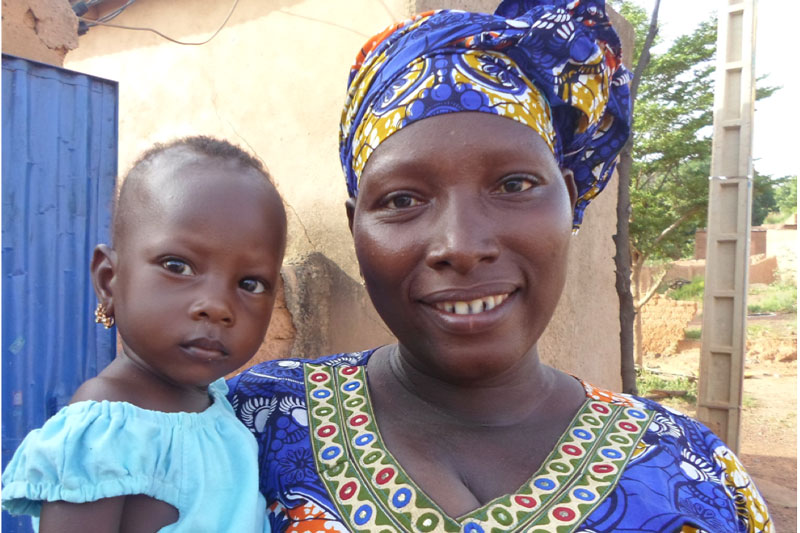
Mah Diarra lives in Lassa, a small community that feels remote, even though it sits in the hills on the western edge of Bamako, Mali’s bustling capital.
Last year, nearly four months into her pregnancy, Mah hadn’t yet seen a doctor because she couldn’t afford to. One day, a friend told her about Mali Health’s new SHARE savings groups, which help women during their pregnancy. SHARE, or Savings for Health And Reproductive Empowerment, helps mothers to save for all the costs associated with their pregnancy, including prenatal care and delivery at a community health center.
Mah met with one of Mali Health’s animateurs, the community members who support and coordinate the savings groups. She enrolled and immediately started to save money to pay for the costs associated with her maternal care and delivery.
Women in savings groups save and lend their own money for group activities. Mali Health encourages them to use funds for health purposes and offers health education sessions at each meeting. Women learn about the most common and dangerous diseases, including malaria, malnutrition, diarrhea, and respiratory infections, plus effective techniques to prevent them. They learn about the benefits of prenatal and postnatal care, and of giving birth in a health center. Women also learn financial management skills that can help them to build greater financial independence.
Today, Mah is the mother of a beautiful, happy little girl. Mah knows that her daughter’s health is due in part to her ability to receive all her maternal care. She was relieved to deliver safely in the health center, but knows most women do not have the same experience. In fact, only 56% of women in Mali have a skilled attendant when giving birth.
Because of her experience, Mah now reaches out to other women in Lassa, encouraging them to enroll in SHARE. She speaks proudly of her experience, with her daughter at her side:
Following my prenatal care sessions with a doctor, I carried my pregnancy to term in good health! Before I joined my savings group, I had no knowledge about my pregnancy, the danger signs, and everything else that comes along with motherhood.
I joined the SHARE group four months into my pregnancy. The doctors advised me to attend all of my prenatal care (ANC) visits. With the help of other women in my group, I saved 750 CFA (~$1.30) every other week to help pay for my care. Meanwhile, Mali Health gave me a grant of 5,000 CFA (approximately $8-9 USD) to support my delivery in a health center.
These many benefits of the Savings for Health program allow all of us to be satisfied, happy mothers.
Mah encourages other women in her community to join SHARE
In 2014, Mali Health launched an mHealth program to help monitor the health of families in our care. The app guides our health workers through a standard set of questions and helps ensure consistent and efficient care. For example, the technology helps to accurately identify the severity of malnutrition by calculating a child’s height-to-weight Z-score. It can also help detect early warning signs to encourage intervention before a child falls into undernourishment.
As we roll out the technology and help our team become accustomed to it, they recently learned how powerful this new tool could be. During a routine visit, our community health workers found a child urgently in need of care. But when she didn’t receive it, they used their training, backed by their mHealth data, to become her advocate. Here’s what happened:
Last week, one of our community health workers visited a mother whose 20-month-old child was underweight. Using her training, our health worker instructed the mother to seek treatment at their health center immediately.
The next day, four CHWs returned to the home to learn how to do a malnutrition follow-up using their new mobile application. The follow-up requires the CHW to recheck the weight and the brachial measurement of the child. The brachial measurement is the circumference of a child’s bicep, a common method of identifying malnutrition, and is indicated by a range of green, yellow, and red levels. This child’s brachial measurement was red, and the weight-for-age calculated by the mHealth app indicated severe malnutrition. The child only weighed about 6 kg.
The mother explained she had gone to the health center that morning for the malnutrition program, but was sent home. The staff said her child didn’t meet the criteria for the program; the young girl was not malnourished “enough” to receive treatment. Our team then decided to accompany them back to the health center, because the child was clearly in need.
However, as soon as they arrived, they encountered intense resistance from the staff. One claimed she remembered the child from earlier and that she weighed 10 kg — far more than the 6kg our health workers had measured. Our team insisted they check again.
The staff measured the girl again and placed her on their scale, determining this time that she weighed 7kg. Looking at their weight-for-height chart on the wall, the health center staff stated the child was only mildly malnourished. Our team insisted they weigh the girl again on our scales (which every community health worker carries on home visits). The staff agreed.
When they did, everyone saw the child only weighed 6 kg based on the scales of two different health workers. The staff claimed the scales were not correct, so our team insisted they take the girl’s brachial measurement. After more protest, a staff member finally took the measurement, but did not fully secure the measuring tape. She left a small gap between the tape and the child’s arm, so the result was yellow instead of red. When our team pointed out the error, the staff member stated that was how she learned to conduct a brachial measurement.
At this point, still determined to demonstrate the young girl needed care, one of our CHWs took the child to weigh her on the health center’s scale herself and, contrary to the staff’s measurements, and measured her at 6 kg. They continued to push for the child’s inclusion in the malnutrition program. After several minutes of discussion, the staff relented. A staff member retrieved several sachets of Plumpy’Nut, an effective nutrition supplement, and gave them to the girl’s mother.
Once home, our health workers explained how to deliver the supplement to her daughter most effectively. They encouraged the mothers to return to the health center each Wednesday to have her child weighed and to receive more of the supplement until she reached a healthy weight.
It took guts for our four health workers to stand up to the team at the health center. Without their intervention, the little girl never would have received care. Without care, a child with such severe malnutrition could die; in fact, it happens often. Mali Health CHWs are well-trained and they demonstrated their knowledge with confidence, even going against higher authorities in the health system when they knew those authorities were at fault.
Their story illustrates why a strong team of community health workers are so essential to advocating for mothers and children in their community. We are so very proud that ours had the courage to do exactly what they are trained to do: to make sure every mother and young child in their community has access to the best care possible.