It is Wednesday, February 3, 2021, Aminata’s 3rd day in her new position with Mali Health. In the early morning at her desk, we asked Aminata to share her feelings about her journey and new role.
I am Aminata Seydou Traoré, I’m 29 years old, and I live in Kalabambougou in Commune IV of Bamako District. I have a Master’s degree in Law with a Judicial Career Option from the Faculty of Legal and Political Sciences of Bamako.
Aminata began working at Mali Health in February 2018 as a savings group facilitator, an animatrice, in Kalabambougou in our Women-Led Health Financing (WHF) programs. While she was serving as an animatrice, Mali Health supported the launch of one of our first cooperatives in Kalabambougou. Aminata brings extensive experience implementing our WHF strategies, but she has something even more valuable. She brings understanding and knowledge from three years of listening to and directly supporting women in her community. Reflecting on her time at Mali Health, Aminata tells us:
At first I wondered how I should go about meeting the goals that were assigned to me. Then little by little, I was able to fit into a team full of diversity. The questioning gave way to confidence and enthusiasm; then I said to myself that I have a lot to learn with this organization. My personal goal was to be able to be in a management position in the program in which I work. With the position of Program Assistant opened, I thought to myself – now is the time. So I applied and was right to believe it and give it a try.
She was right to believe in herself and try, and today Aminata is ready to thrive in her new role. Ambitious and always committed to serving her community, Aminata is also active in civil society organizations, including the Coalition of African Alternatives Debt and Development (CAD-Mali) through an organization known as Association of Youth for the Development of the Municipalities of Mali. We look forward to the enthusiasm and energy she will bring to her work with thousands of women across Bamako.
*Aminata is stepping into the role once filled by Aïssata Touré Kouyaté, who was recently promoted to Storytelling Manager.
When COVID-19 arrived in Mali, it quickly interrupted lives and livelihoods in the peri-urban communities we serve. Most families with whom we work make their livings in the informal sector. The first COVID-19 prevention measures put into place in Mali significantly restricted their work.
But since 2018, we have worked with women to develop more accessible livelihoods through activities which they can control and are closer to their homes. With resources in their hands, women can make decisions that improve the health and wellbeing of their children and families. They can purchase nutritious food, buy soap and other prevention measures, seek healthcare, and enroll their children in school.
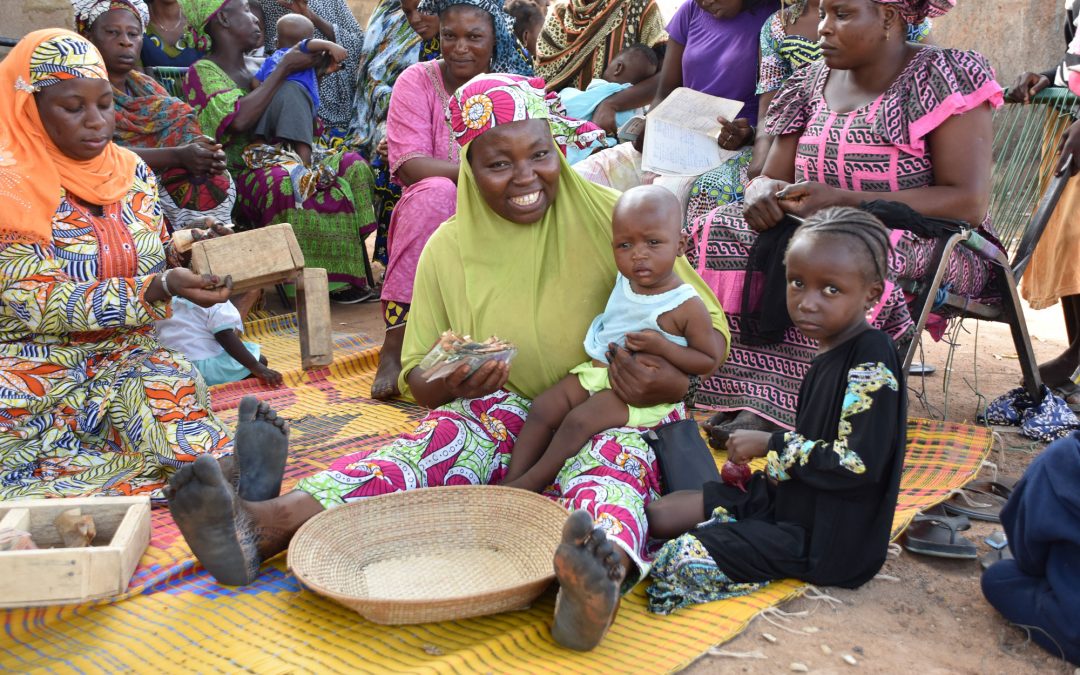
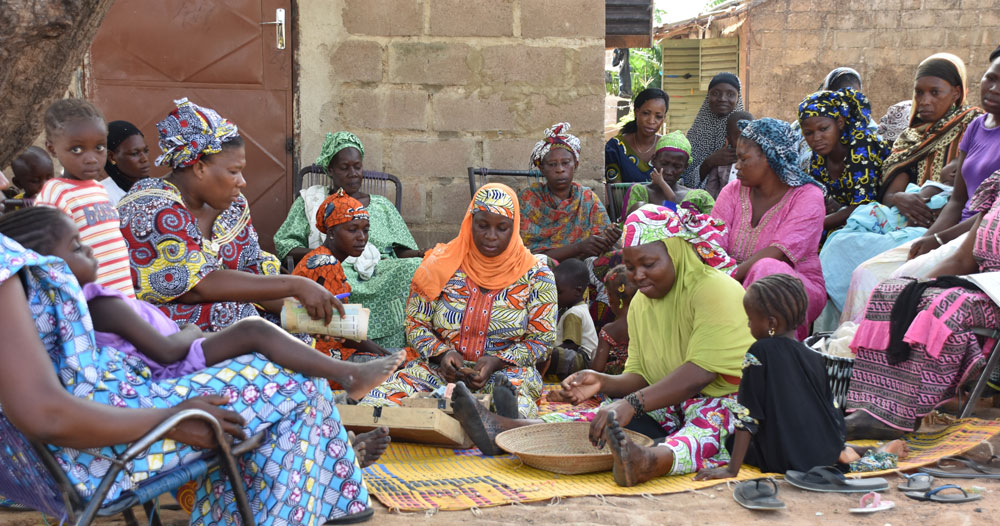
While our savings groups could not meet safely at this critical moment, the cooperatives, already equipped with PPE and operating in open outdoor spaces, could. Now, they are not only operating, they are growing.
In those early days as COVID-19 began to spread globally, we encouraged the soap-producing cooperatives to begin making as much soap as they could. Whatever they did not sell to their neighbors, we purchased and provided to our partner health centers and distributed to families most in need.
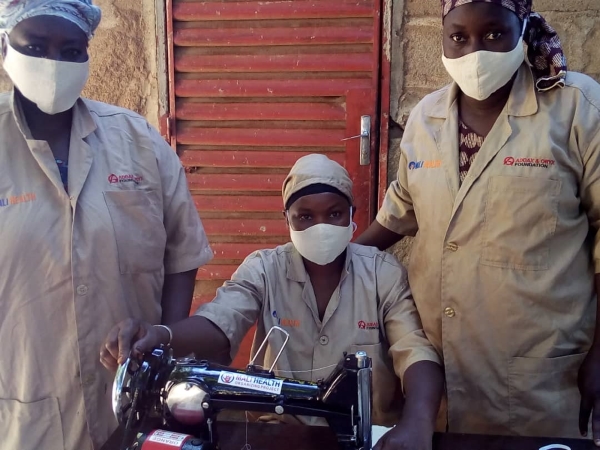
As the threat of COVID became clear, we decided to help women start sewing masks, using local cotton fabric. Our team quickly identified 30 women who already had basic sewing skills. We helped them to incorporate their cooperative and secure 5 sewing machines, along with the materials they would need. A very big thanks to Women International Leaders of Greater Philadelphia for the funds to purchase the equipment and materials.
The cooperative got started quickly and set the prices of adult masks at about $2 (1000 FCFA) and child masks at about $1 (600 FCFA). Mali Health was one of their first order; we purchased more masks for the staff at our CSCom partners in Bamako and Sikasso. As with the other cooperatives we have supported, the sewing cooperative not only provides much-needed revenue to families during the pandemic, they are also making very valuable resources available and accessible to peri-urban communities were resources are extremely limited.
We are even taking steps forward in helping the women who will lead a new union to support the cooperatives. In collaboration with the Direction Régionale du Développement Social et de l’Economie Solidaire du District de Bamako, women will receive training in leadership and management skills to help them develop and lead a resource of their own. Creating an association allows them to support and grow their cooperatives, while helping more women in peri-urban communities to launch cooperatives of their own. Stay tuned for more details!
Joe (board member) and Tara (US Director) visited Mali in February 2019 and were honored to host a few American guests for an eventful week, including the celebration of our team of community health workers, and their amazing accomplishment of not having lost a single mother or child in their care since January 2014 (read more on that here). Below is another special experience from that trip, written by Tara.
Getting to Lassa requires a bit of a climb. Like Sikoro, it is north of Bamako, where the hills turn into cliffs. It is a different landscape.
On our way to visit a savings group, we started with a call on the village elders. Traveling with more Americans than usual, they received our small delegation graciously in a thatched-roof building that is surely often occupied by important community meetings and discussions.
Seated on the ground on an animal skin, the eldest offered very warm and customary greetings. We offered a traditional gift of kola nuts. Interpreting the exchange for our guests – Bambara, French, English – English, French Bambara – makes it feel more profound and ceremonial. Receptions like these are an honor and a social performance of respect – and I will never tire of them. I’m unsure if Mariam (our Mali Director), or the rest of our team, share my enthusiasm and awe. They always represent Mali Health with the immense Malian graciousness that is gratifying to this Southerner to watch.
Accompanied by two of the elders, we continued a bit farther up the slope. Noting very large piles of firewood (and suddenly realizing the lack of trees), they inform us that the production of charcoal was the primary revenue-generating activity. The informal economy is how most of those living in peri-urban communities, especially women, get by. They tell us that Lassa used to be like a rainforest – a small oasis above the city – but the dust the characterizes the rest of Bamako now seems to dominate here, too.
But as we continued, mango trees began to appear and grow in size. When we turned the corner to where the group was seated, we encountered one of the largest mango trees I’ve seen in Bamako. Mango trees provide very welcome shade here along the edge of the Sahel; thousands of women’s groups meet beneath them across the continent every day. They are amazing trees – thriving in even the harshest of conditions.
Again our small delegation is welcomed graciously, this time with song. We observe the opening ritual of the meeting – the diligent taking of attendance, reporting, counting, and recounting of the amounts saved in their two accounts: one for health expenses and one for income-generating activities.
Then, one at a time, every woman rises and brings her contribution, 100 FCFA, or about $0.18. The status of loans is reported. The funds are counted, recounted, and reported to the group to be held in the collective memory. At the beginning of their next meeting, the group will be asked how much should be in the accounts. The funds will be counted and the numbers will agree.
At the conclusion of their savings activities, the visitors are welcomed to ask questions. This Director, eager to report back to our wonderful supporters, asks a few (rather standard) questions:
How many of you have used the health fund for yourself or one of your family members? About 80% of hands go up.
What kind of things do you take the non-health loans for? Women share that here in Lassa, they are gardeners. They buy inputs and tools for their gardens with the loans. Things like fertilizer, small tools, or seeds they don’t save themselves.
What can we as Mali Health do to better support your group? They want support to form a cooperative too… word travels fast. Though we are testing the cooperatives in only two communities – not at all close to Lassa – the other 5,000 women in Mali Health savings groups are watching closely.
Great – we would love to help you do that. If you had a cooperative, what would you like use the funds for? To send our children to school, they say.
Hmm… no mention of health. I say as much to Mariam and she nods – but she’s already two steps ahead of me. I ask her if I might ask about the health center, how do they find the service there? How is the quality of care? We have worked with the health center here as an advisor to another community project, but we just added the CSCom in Lassa as a full quality improvement partner a few months ago.
Thanks to our partnership with OSIWA, we are expanding our participatory quality improvement approach – this time with a particular emphasis on women’s participation at all levels. These are some of the very women who we will be relying on to provide their feedback and leadership – to participate actively in the improvement of the health center. Mariam knows what is coming, but gives me the go-ahead.
Could you tell me about your health center here in Lassa? What has your experience been like? What do you think of the quality of the care you receive there? A few women weigh in, saying they are satisfied with the care. Many have taken their children there and have received effective treatment.
I turned to Mariam – are they just telling us what we want to hear? Do they know we want to hear their real experiences? Mariam smiles at me, knowingly, as if my understanding finally catches up to hers. We discuss that the time is late and I say that we can just let it go. But, it would be nice to encourage them to share more. Their experiences are essential for us and the health center to hear and understand. We want them to know how important they are, but is now the best time to have this discussion?
As I discuss with Mariam, the group becomes restless. We have already taken up too much time – they have households to manage, children to mind, and meals to prepare. Having stopped interpreting our side discussions, I’m worried I’m boring our guests who are not accustomed to the dryness and heat.
But then Mariam turns to Gaoussou, the dynamic Director of our Community Capacity Building department, and says a few things in Bambara. Though her Bambara is excellent, she usually prefers to speak in French and have Gaoussou interpret for her – another process I enjoy. This time, she speaks directly and deliberately to the women in Bambara.
Mariam tells them she knows there are issues at their health center. She explains why they are so important, not only to us, but to their health center and community. She describes our strategies for sharing feedback from women with the health centers and that we need more women to become leaders in the community association that manages the CSCom to help advocate for better care.
Though we have just taken them on as a full quality improvement partner, Mariam knows the center well. She gives the names of all the personnel – including the new director. She conveys to the group that she knows what happens there – she knows what they know.
One of the visiting elders weighs in.
Listen to her words, she knows your health center perhaps better than you – why don’t you share your experiences?
After a brief pause, one woman starts pouring out her story – sounding more urgent and frustrated with every word. After hearing about the importance of delivering at the health center from her savings group, she was finally able to convince her brother to let her take his wife to deliver at the health center. Despite going into labor in the center, her sister-in-law was never attended to. She delivered, without being touched by a single provider. She vows to never return to the health center.
Other women weigh in with similar stories of neglect, lack of respect, or poor-quality care. They say that when they take loans from their group, they take extra so they can pay for the transportation to take their children to another CSCom nearby. They avoid their own health center if they can.
Throughout their testimonies, Mariam nods, again knowingly. Their experiences are why we started our quality improvement work in the first place. What is the use of helping women overcome the barriers to accessing care if the care they receive does not help them? This is why our approach of addressing both access and quality is so important.
Mariam thanks them for sharing their stories. She says it is because of their experiences that we are now working with their health center to improve. She reinforces once again that they are a very necessary part of the process and that we will continue to support them and the health center until they are truly satisfied.
We close our meeting with exchanges of gratitude all around. We take a group photo under a branch of the grand mango tree.
Des Bonnes Mamans savings group in Lassa, with visitors
Though very aware of the time we have consumed, but not wanting to leave them after such an enlightening visit, I very timidly ask Gaoussou if I might just see one of the gardens they mentioned? Maybe take a photograph of one of the cultivators in her element?
We are again graciously ushered up a hill, through the barriers that keep out renegade goats, chickens and children and into beautiful, lush gardens. Yams, peppers, tomatoes – as far as the eye can see. I’m told that nearly every woman in the savings group has a garden and they sell their excess produce in the markets. No more charcoal.
While many families we serve come from rural areas where cultivation is the mainstay, there isn’t much room for gardens in densely-packed peri-urban communities. Lassa, situated along the ridges above town, has a bit more room – so the women are growing.
After more thanks and farewells, I’m still processing the lessons this group taught us, but mostly feeling very proud of our team and their dedication to ensuring women are heard and can lead. As we descend from the gardens, the elders share that instead of cutting trees, the community is now working on replanting them. Between the trees and the gardens, they have already noticed a difference in their climate.
They say the rains, which started to pass over Lassa into the next valley when the trees were all cut, have returned.
Sokona Sangaré could rightfully use the title President Sangaré if she wished; after all, her savings group companions have elected and re-elected her to serve as president of their savings group since they started meeting in 2014. But she’s too humble for that — “It’s because I can read and write. That is why they chose me to be President,” she says — but she recognizes the important role she plays: “They continue to vote for me every year because I have won the trust of the group.”
Sokona and her friends live in Lassa Faranida, a small hillside community on the northwest edge of Bamako. It’s very remote, and infrastructure is weak; potholes dot the dirt roads, drinking water comes from wells, and only a handful of houses are wired for electricity. It’s no wonder that the women of Ben Kadi savings group (a Bambara phrase meaning “mutual understanding”) used to have great difficulty paying for their families’ health expenses.
Sokona explains:
” Before Mali Health helped us start this savings group, when my children or I would become sick, we didn’t have the money to get to the doctor quickly. It was difficult, sometimes impossible, to get loans from family or friends. Now all of us women in Ben Kadi can get a quick loan to get ourselves or our children to the doctor at any time day or night because I keep the healthcare lock box and key in my house. Whenever there is an emergency or urgent medical need the women know to come to me to get a health loan because the money belongs to all of us. “
As president, Sokona is responsible for protecting the lock box containing all of the money they’ve saved to support healthcare expenses; another group member holds the lock box containing funds that women can draw on to support activities that help to build their income. Sokona also facilitates every group meeting, tracking attendance, and supporting group members as they request and repay loans.
Sokona has worked hard her entire life, not only for herself, but for her community. While most women living in peri-urban communities like Lassa Faranida did not have a chance even to complete primary school, Sokona graduated from high school and then college before becoming a teacher at the local primary school. In the past, she earned extra money by selling charcoal from her home, and she looks forward to learning how to make soap to sell to local families. Ben Kadi is another outlet for her to support her community and the women around her, and she speaks proudly of her groupmates:
“I really enjoy being president of this group because we are all women, we all help each other and we all work together.”
“We have been meeting as a group and saving for small business needs for ten years,” says Mariam Traoré, the president of her savings group ‘Sigida Yiriwa Ton 1,’ which in English means ‘Association for Community Development.’ “Each member contributes CFA 100 [about 17¢] every week. Half of this amount goes into the small business box and the other half goes into the health savings box.” The group meets at Mariam’s house in Sebenikoro, on the front porch under a red tarp to protect the women from the hot sun as they meet.
Savings groups, or tontines, have been around for decades in many West African countries. It is a traditional way for women to form a collective that allows members to pool their money and share it fairly among themselves. It is popular and even essential in situations of economic uncertainty because this type of collective savings can provide financial and social security to group members.
Fatimata Nyere, the group’s facilitator from Mali Health, says, “Mali Health came to Sebenikoro in August of 2016.” She was tasked with approaching existing women’s groups in this community about making some of their savings available to use for health and sanitation needs that the group was facing, rather than just focusing on small business opportunities. “When I arrived,” Fatimata says, “the group asked me if I could teach them how to make soap.* I wasn’t able to do that, so I suggested that the group buy cases of soap to distribute to its members every two weeks. They could use funds from the health savings box to cover the cost.”
Mariam explains, “We need soap because we lack sanitation here in our community and there is a lot of sickness. Right now, there are mostly cases of malaria, but we also have colds and coughs.” Soap won’t stop malaria, but it can help stop the spread of diarrhea, pneumonia, and other respiratory infections that are prevalent in Sebenikoro and that can be life-threatening to young children whose immune systems are still developing. “Soap can be used to clean everything,” Mariam continues. “I clean my children, myself, the clothes, the dishes, and we even wash our hands with soap before we eat.”
The group has decided to buy cases of soap for about $14 every two weeks using the funds the women have contributed to their health savings box. Three bars of soap each are distributed to half of the women during the first part of the month, and the other half gets their soap during the next distribution in the second half of the month.
“Every member of our group is married, with children. We also use the money in the health savings box for doctor visits and medicine when our families get sick, including our husbands, because men and women are the same,” says Mariam. Her savings group is different from most; other groups in Mali Health’s program generally reserve their funds for use solely by group members and their children. In Sebenikoro and other communities around Bamako, family finances are retained and controlled by men, and women don’t typically have the ability to spend money without permission from their husbands. Mali Health’s savings groups are one way of promoting women’s agency and independence by giving them the freedom to spend the group’s savings on important items like soap or medicine without delay or permission.
“Mali Health helps us to share the cost of doctor visits and any medicine we need when our young children are sick,” Mariam says. “They even help some of us who have no money.”
She calls out to the group, “Let’s clap our hands for Mali Health and all the good work they are doing here, and hopefully the good work will stay for years to come!” On Mariam’s command, the group claps once, CLAP, then twice CLAP, CLAP, and finally three times, CLAP, CLAP, CLAP, and the group in unison shouts, “MALI HEALTH,” and they erupt into laughter and smiles.
—————–
* The women in our programs have repeatedly expressed an interest in learning new skills — like how to make soap — that they can use to raise their family’s income and self-sufficiency, which will help to further improve their access to primary healthcare. This year, Mali Health will work with the women from several savings groups on a pilot project to launch small cooperative businesses, giving these women a chance to learn and market new skills. We’ll support and follow the women closely to see whether these cooperatives can help to sustain, or even expand, the health improvements the women have made through their savings groups.
It’s late afternoon and women in Kalabambougou begin gathering for their weekly savings group, in the shade of an old moringa tree. Korotoumou Camara, 25, is there with two of her six children. She is steeping the first round of sweetened green tea for the group’s members. There are freshly roasted peanuts for sale and another woman is selling chunks of juicy watermelons. One group member braids another’s hair, and a young girl is hanging brightly colored clothes on the line to dry. This is where the members of Ben Kadi (mutual understanding) and Yelen (light) meet to save for their future needs. The group has two names because there are two things the women save money for: healthcare and small business activities.
Korotoumou is the group’s treasurer. When she isn’t meeting with the other women, she is busy with her small business selling vegetables at the nearby market or doing the never-ending work to keep her home functioning (cooking, cleaning, minding the kids). Her oldest child is eleven and her youngest is the nine-month-old girl in her lap commanding her fullest attention. She thinks education is important, so her five school-aged children are all enrolled at the nearby public school. Korotoumou and her husband, a local brick mason, had limited education when they were younger. He attended a traditional Islamic school, or madrassa, for eight years and she attended a public school until grade 5.
Korotoumou counts her group’s weekly savings as group members observe
Korotoumou was in a savings group before Mali Health introduced the idea of adding a health savings aspect. She says that contributing members feel a new sense of ownership for their family’s health needs. Before the health savings group, when one of her children required a visit to the doctor, she was unsure how she would pay for the visit and any medicines. She did not like asking family or friends for a loan because it made her and her husband feel embarrassed. Now, with the ability to take a loan from her savings group, they feel a sense of pride in being able to do for themselves what so often they had to rely on others for.
There was a health center built in Kalabambougou a few years ago, but it never opened. There is a solar-powered water tower that is empty and beginning to rust. A maternity ward with gurneys and delivery areas are collecting dust and cobwebs. The grounds serve as a temporary farm field for the family tasked with caring for the vacant health center until whatever local political dispute preventing its opening is resolved. Korotoumou shakes her head and laughs when talking about the unopened health center; she doesn’t think there’s anything she can do about it. Though, it would be convenient to have a closer health center. The closest Mali Health partner is over three miles away, so she uses the health center in the next town.
When one of Korotoumou’s children falls ill, she knows it immediately. Instead of running around playing with friends, she says they remain at home asking to sleep and lay down. At this is telltale sign, she now goes to the health center with confidence that she can afford the visit and treatment. She and her husband still wait to see if their symptoms clear up on their own, but she doesn’t wait for her children because she knows they are at greater risk and require timely treatment. The most frequent illness the family encounters is malaria, especially during the rainy season when the mosquito population booms. She and her husband still use traditional herbal medicine to treat less severe cases of malaria because it is cheaper than western medicine, and in their experience, just as effective.
The institutions that Korotoumou and her family rely on are fragile and it is difficult for her to feel secure in their future. The fear of not being able to provide for their children’s health needs used to keep her up at night. But with the support from her savings group, she can now rest a little easier. The collective nature gives her confidence that her community cares and it instills in her a feeling of agency. She knows she is contributing to better health – not just for her children, but many other children in Kalabambougou.
About Kalabambougou
Kalabambougou is a peri-urban community not far from the busy streets of Bamako’s city center. After leaving the paved roads behind, drivers go from dodging the moto bikes that weave in and out of traffic to skirting the car-sized pot holes formed by the deluge of the rainy season. Residents have recently filled potholes with large boulders that they will smash into smaller pieces with sledgehammers. It’s daunting work, made more intolerable by the relentless heat and humidity. But maintenance of these dirt roads is vital because they ensure access to Bamako, the markets, and the closest health center.




 As president, Sokona is responsible for protecting the lock box containing all of the money they’ve saved to support healthcare expenses; another group member holds the lock box containing funds that women can draw on to support activities that help to build their income. Sokona also facilitates every group meeting, tracking attendance, and supporting group members as they request and repay loans.

 Savings groups, or tontines, have been around for decades in many West African countries. It is a traditional way for women to form a collective that allows members to pool their money and share it fairly among themselves. It is popular and even essential in situations of economic uncertainty because this type of collective savings can provide financial and social security to group members.