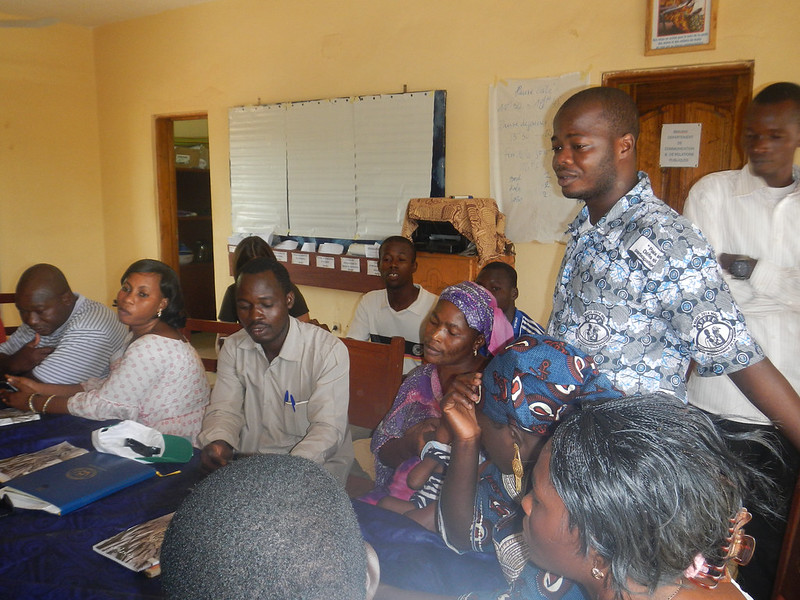
Mali Health believes in building on a community’s existing resources. We do not want to replace them, because we want to enhance them. Often, a community’s greatest resource is its residents – people deeply committed to improving life for their families and neighbors.
A central tenet of our organization has always been to build deep connections to, and within, the communities we serve. We believe it is the only way we can develop local, long-term solutions.
That’s why we deploy a team of 50 community-based health agents who can sit across from mothers, listen to them, and answer their questions. They are an essential part of our strategies to improve community health. They are also an essential part of how Mali and the world will achieve universal health coverage, through improved community health.
One of the greatest examples of the local leadership that is changing the face of community health in Mali is our team’s new leader, Dramane Diarra.
Dramane has been a part of Mali Health for 10 years, having joined us in October 2009. He has held multiple roles over the past decade. Beginning as a health promoter, he rose to lead the entire Health Promotion team. Because of his leadership of his department and several other important projects, like our role in the Ebola response and the subsequent Global Health Security Agenda, Dramane became our most senior program leader at the beginning of this year.
Dramane has as much experience and knowledge of Mali Health as anyone, and perhaps more than anyone.
But it is not just his past roles in our organization that position Dramane well to lead our team. Dramane’s role in Sikoro (see more from Sokone below) and his belief in the power of communities to improve community health, make him the ideal leader for the hard work we will do going forward.
We are at a critical time. We want to from collaborating with our community partners to implement effective strategies, to helping them sustain them. We’ve made progress, as with our participatory quality improvement approach, but our goals are immense and long-term. To reach them, we need someone who understands the communities we serve from within. We need someone who knows how to motivate and support other community leaders to join him – and that is Dramane.
Here’s how Dramane sees his work:
” My commitment to community health comes from my firm belief that in every community, there is the power to improve health.
This power, at times, can be disjointed or poorly expressed, or even misunderstood and undervalued. But all it takes is to highlight it and to show communities how to use it; then the results will follow.
Everyone, whatever her level or his position, comes from a community; it is to this community that he or she returns at the end of every day. If every community understands the need to come together, every community can improve health.“
As our work to improve maternal and child health continues, we are recommitting ourselves to strengthening the resources and leaders on the ground – helping them to see and use their power, you might say. In order to build local and resilient community health systems in Mali, we will rely on leaders like the one Dramane was in Sikoro in 2006, and the one he is today.
The most powerful, dedicated, and impactful community health leaders come from within – and we are just getting started supporting them. Now, we are thrilled that our team is led by one.
Sokone is a community health worker in Sikoro. She’s known Dramane for many years, and here are her thoughts about our new team leader:
” I have known Dramane since he worked at the Sikoro Animation Center before joining Mali Health. He contributed greatly to the development of Sikoro as an educator and by helping families enroll their children in school. That is the work that helped him to become known, respected and solicited by the people of Sikoro. Since his arrival at Mali Health, this son of Sikoro has been steadfast in his commitment to help disadvantaged families have access to quality health information and healthcare.
Like all the community health workers, Dramane helped me a lot personally. He has helped us become knowledgeable, competent actors so that we can inform the families in our community. This constant support of our team has led to dramatic changes in the health of children and families in Sikoro.
Hard-working and courageous, Dramane has always been available for the cause of Sikoro, from his childhood to this day. “
While the fields of public health and medicine (among others) often invoke compassion as a grounding principle, its application to our training and practice as professionals is still developing. We recently had the chance to reflect on compassion and its role in our work, and we realize it a conversation that we want to continue. And we’d love for you to be a part of it. Share your thoughts with us on social media, or send us an email.
In mid-June, we attended the IZUMI Partners Meeting in Boston. We are so fortunate to work with IZUMI and they have been a strong, steady partner as we have developed our approach to improve healthcare quality, governance, and community participation at community health centers.
IZUMI Foundation supports global health around the world and is part of a group of foundations originating in the Shinnyo-en order. Shinnyo-en is a Buddhist denomination originally established in Japan that is grounded in values such as kindness, compassion, and caring for others. In fact, one translation for the Japanese word izumi is “heart of compassion” and in the Shinnyo-en tradition, that is represented by a deep commitment to social awareness and justice.
IZUMI Foundation is driven by the principles of hope, health and compassion and we are delighted that the one thing that stayed with us the most from their meeting was not something we learned about global health or nonprofit leadership, but something far more universal: the role of compassion.
The keynote speaker at IZUMI’s meeting was Dr. David Addiss, an advocate for compassion in global health, and he spoke about its necessity in our sector. Compassion is a familiar value for most of us, but Dr. Addiss differentiated compassion from other values and grounded it clearly in our field. Compassion is not rooted in sympathy or pity – those connote differences in power, even superiority. Instead, compassion is rooted in solidarity and an acceptance of our interconnectedness.
Though some may view it as an unscientific discourse, he noted that compassion is a skill that can be practiced and there is a growing field of neuroscience devoted to understanding it. Compassion can be taught, and learned. Dr. Addiss asked us to consider and interrogate compassion – as the desire to alleviate suffering – as the inspiration and motivation for many of us and as the ground in which our field is rooted.
Though we are now back in the busy day-to-day of our roles, the idea of compassion has remained with us. It has encouraged us to reflect on the role it plays in our organization – and in our partnerships with communities in the US, and in Mali. As a small community organization, we often think of Mali Health as generating so much of our identity from the communities we serve in Mali – the proximity of our team within them and our service to them – and the community in the US who chooses to support that work. But if we take a step back and ask ourselves why that identity has meaning for us – the answer looks much like compassion.
At its best, compassion is about solidarity, about making connections across difference out of a recognition that we are linked. While compassion might stem from conditions of inequality, those we serve are not the objects or recipients of our charity. They are equal partners in eliminating suffering and improving the wellbeing of all.
But sometimes, that distinction isn’t always clear in our sector. There can be a downside to compassion, especially when it comes to examining our motivations and choices as individuals. Helpers of all kinds can burn out and people make poor choices in the name of serving others. At its worst, those operating in the name of compassion insist on maintaining power and agency over others – blind to their own biases and the oppression they perpetuate. And we still watch with concern as the power that exists in our sector not only can allow poor leadership or poor development work, but can incentivize it. Compassion alone is not enough to solve these challenges, nor is it the only value that should direct us. But we wonder if it might not be the kind of guiding, and grounding, principle from which global health as a field, and we as practitioners within it, could benefit.
In Mali, we see many applications for compassion in our daily work. The idea of “compassionate care” in a clinical or medical setting is not a new idea, but compassion is not a term we often use in public health. Our work and the way we train our team is grounded in principles of respect and care, but compassion still seems distinct.
Yet we see it in our community health workers going out each day to tend to their neighbors – doing so out of a sense of improving their communities and protecting the most vulnerable within them. We see it in our office staff, who have a strong sense of service to others and have dedicated themselves to our mission and values.
But perhaps where the idea of compassion resonates most for us is in our work to improve the quality of primary healthcare for the most vulnerable. Within quality improvement, there is a well-defined emphasis on the delivery of respectful maternal care that ensures all mothers are treated with equity and dignity. Interestingly, compassion does not often accompany these principles in the literature. But with its insistence on recognizing the human connection between a provider and a patient, compassion seems inherent in the current quality, equity and dignity (QED) framework in maternal and child health.
But there’s more we’d like to do.
Ethiopia’s Health Systems Transformation Plan discusses the creation of a compassionate, respectful, caring (CRC) health workforce, embedding compassion not only in quality, but also a building block of health systems strengthening (HSS). HSS can be one of the “nameless, faceless” areas of global health that the call for compassion is seeking to humanize – and we’re watching closely.
We are imagining how we might facilitate conversations with our team and our partners about the role of compassion not only for their motivations as individuals, but also within their daily work. We are thinking about what connections we might make between our emphasis on the patient experience in our quality improvement work, and how compassion might further improve our partners’ ability to provide more patient-centered care. Might we help our partners build a compassionate, respectful, caring (CRC) workforce?
Our ideas for how we might integrate compassion into our work are just beginning…
We also know that members of the Mali Health community are motivated from a place of compassion. You have told us time and again that you see solidarity at the heart of our work, and that is why you support us. You share your compassion with women and children in Mali, and us, because you believe that no one should suffer because they don’t have access to quality healthcare. Beyond your participation in our community, many of you are physicians, educators, or helpers of some kind. Your compassion, your desire to alleviate suffering, emerges in all areas of your life.
For us both, reflecting on compassion has led us to some rich and thought-provoking places. We are thinking about its role in our motivations as leaders, in the organization and team we support, and in our field. We wonder if you might have similar insights?
We want to open up the conversation about compassion in our communities – both in the US and in Mali – and we invite you to be a part of it. Let us know your thoughts about the role of compassion in your life – personal and professional. We’d love to hear from you. Send us an email, or leave us a note on social media.
This post was written by Mali Health Board Chair Dr. Joe Camardo, after his recent visit to Mali.
At 8AM I walked out of the NIH guest house at Point G, which is settled on a hill above Bamako, into the heat of the Malian morning. The terrace provides a view of Bamako on the plain below; what a place. Just flat and sprawling as far as I can see, and from here it is just quiet. But, five minutes in the car and one joins the crowd of commuters. Cars, motorbikes, sotramas, pedestrians; courtesy and good judgement orchestrate this constant flow of movement, since there are few traffic lights. Bamako is rich in spirit and like Mandé music it seems to have a rhythm and a story.
So, we (Samba my driver and I) cross the town and arrive at the Mali Health office. This starts a week that allows me to see our team, the families we serve, and our health center partners. It also includes visits to some of the government officers who are tasked with the vision to lead the country to a place where the spirit of the people is matched by the services and material goods all of us have come to expect.
One of our concerns about Mali Health is whether we can convey to our supporters how much of a difference they make in a place so distant, so different, and somewhat obscure, not usually the subject of news stories, except for bad news. But there is some good news:
At CSCom SISSOU, our very first partner health center in Sikoro, there is much activity. They follow our quality improvement protocols and have improved their system for payment, their labs, their water and sanitation. In May, they delivered 100 babies. The team is motivated and they’re responding to an influx of new residents in the Sikoro area. The community health workers in Sikoro/Sourakabougou visit families on a planned schedule, with specific objectives. The health center is raising money to improve the laboratory so it can be certified for additional testing services.
In Sotuba, our community health worker spent over an hour with mothers explaining vaccination, malaria, handwashing, and other simple but important ways to keep their infants and toddlers healthy. They spent a long time in discussions and banter in a combination of French and Bambara (and some arguing with more vocal of the community). The women are illiterate. Since we cannot just provide information in writing, the discussion is one of the few ways to make an impact.
In Lafiabougou, I attended a quality improvement session (in French and Bambara with simultaneous translation by Mariam. Note to self: learn French before next visit). It was great discussion about vaccinations: why are families with newborns missing some of the later doses, how should we make sure the mothers know when to return, how do we make it easy for them to get back to the health center. Another lively discussion including the head physician, the sagefemme (midwife), and the staff of the health center, along with our quality improvement coaches.
In Sibiribougou, I met with a savings group. Of course, this is an opportunity to provide information to mothers. I noticed it’s also a chance to see the babies; though not a real pediatrician visit, even an out-of-practice doctor can see if the baby is thriving or not. This is a great event, lots of laughter, but also serious accountability for the contributions and their use. I contributed a very worn-out 1000 CFA note (about 2 dollars), which generated some applause and laughter and I suppose allows me the privilege of a loan if I need it. I find these sessions to be inspiring; it’s not just the money, (that is important) but it is the sense that these mothers really help each other. It is one of the activities that mothers manage themselves; our animateurs make sure they get together, but the mothers run the show.
Mariam and Joe visit the Ministry of Women, Children and Families
This visit we took the opportunity to visit the Ministry of Health and the Ministry of Women, Children, and Families. We also reminded them of our status as an INGO, recently granted. Though we are a US nonprofit organization, we are incorporated as an international NGO in Mali, under Mariam’s leadership. We visited the Minister of Defense, Honorable Tiene Coulibaly, who is a friend of Mali Health from his time as Mali’s Ambassador to the US. Though a courtesy visit, it was a reminder that one obstacle to progress in Mali is the continued threats to peace in the North, and in the Dogon region. All I could say was that, having visited Mali now three times, that I wish him the best of luck in the job, and told him that for sure the people of Mali deserve peace.
The following comes from Lindsay Ryan, a founding member of Mali Health, as part of Mali Health’s 10th anniversary celebration.
Back in 2006, Mali Health was just an idea – one inspired by the vibrant and resilient community members of Sikoro and the health challenges they faced and articulated with often painful insight. What we all shared then, Malians and Americans alike, was a love for the place and a sense of urgency over the terrible toll of preventable disease, especially among children and mothers.
It turns out that common values and passion can get you through a lot. Back then, it was the sheer challenge of starting programs from the ground up – from matters as small as registering an NGO to those as large as problem-solving how to create a democratic and representative community health action group. Today, the hurdles are those involved in running a large and sustainable organization, one that even weathered and played a pivotal role during the Ebola crisis. I never could have imagined back then how far Mali Health would have come today, both in the extent of its reach and the effectiveness and evolution of its programs. I’m proud to have watched its birth – but I’m much, much prouder of the remarkable leaders and residents of Sikoro who have made Mali Health into all that it is now, ten years later.
The following comes from Erica Trauba, a founding member of Mali Health, as part of Mali Health’s 10th anniversary celebration.
Last month at a friend’s going away party in Abidjan, I met a woman who works in both Mali and Côte d’Ivoire. We struck up a conversation, and I told her that I lived in Bamako several years ago. Invariably, I also mentioned Mali Health. Right away, the woman’s face lit up and she exclaimed that she already knew the national director, Mariam, and was familiar with the organization’s work. To me, this was more than a serendipitous interaction – I took it as an encouraging sign that Mali Health is on the right path and that it continues to be successful in expanding its reach.
Back in the earliest days of Mali Health, I don’t think I ever fully visualized the potential extent of the organization’s longevity or its impact. In 2005, Mali Health was just a budding idea. In the fall of 2006, the team focused mostly on accomplishing tedious, yet essential first steps that would set the stage for all the action to come, like getting permission and buy-in from key local leaders, finding and cleaning a meeting space, and figuring out exactly which paperwork was needed to turn an idea into an official NGO. There were no offices or official programs yet, but no matter! We optimistically fumbled forward.
All those pieces gradually fell into place, amazing people came onboard, and through the dedication of staff, volunteers, board members, and local residents over the years, Mali Health became a full-fledged organization that has since established a strong track record of improving community health in Bamako. Thousands of people have since benefitted from the organization’s services. Now that is something to celebrate!
I left that party in Abidjan feeling encouraged about the power of grassroots development and interpersonal connection. I also felt proud to be part of a group of people who have come together to improve health outcomes for some of Mali’s most vulnerable populations. Now, as we celebrate Mali Health’s 10th anniversary, I feel even more motivated to help bolster this community as we embark on the next 10 years together.
While reflecting on progress, accomplishments, and goals yet to be achieved after her 15 years of community health and development work, Aïssata Touré, Mali Health’s SHARE project manager, tentatively says, “we’re doing the maximum, but we can still do more.” SHARE is a component of our savings group program aimed specifically at bolstering perinatal care and assisted births among pregnant women.
As a lifelong resident of Sikoro, the community where Mali Health was born, Aïssata has been an intimate witness to, and a driver of social transformation within her community. While growing up, her mother founded L’Association Muso Kalanso, The Association of Women’s Education. It was a grassroots community savings and education group in Sikoro, and simultaneously ran a nearby kindergarten. So working directly with pregnant women as Mali Health’s SHARE project manager, Aïssata feels right at home.
At only 26-years old, experience and ambition don’t fully describe the path Aïssata has blazed thus far. “Since I was the first child in my family,” she explains, “I had to believe that I could do anything boys could do.” Aïssata’s parents frequently tasked her with chores and errands usually associated with boys, so she quickly developed a thick skin and personal resolve with which she navigates complicated gender norms today. “The worst,” she laughs, “was carrying huge batteries across Sikoro to get recharged for nighttime electricity. I think those experiences pushed me to do more, to expect more,” she says.
Mali ranks among the countries with the highest gender discrimination in the world. Aïssata consciously lives her life as a positive example for other young girls in Sikoro, especially her own 9-year old daughter. She was the first in her family to attend university, receiving a degree in Economics from the University of Bamako. “Women can do anything. We just have to be brave.”
Since I was the first child in my family, I had to believe that I could do anything boys could do…Women can do anything. We just have to be brave.
– Aïssata Touré
At 13 years old, Aïssata volunteered as a peer-educator throughout her district’s school system to perform theater skits about about HIV prevention and treatment. “Oh yeah! I was terrified before my first performance,” she remembers. Within a few years she was running health advocacy radio programs throughout Bamako as assistant director.
By 2013, Aïssata was already on a list of community surveyors that Mali Health contracted to conduct various impact evaluations of our programs in Sikoro. At the time, she was working on her radio program, women’s savings groups, and maternal health volunteer work with the Red Cross. When she saw a job posting for Mali Health’s Assistant to the Advocacy and Radio Program, she took the opportunity. From then on, “every year I wanted more. In my performance reviews I would push for more responsibility.” The following year Aïssata transitioned to Communications and Public Relations Assistant, and the year after to become project manager for SHARE, her current position.
What’s the connection between her mother’s lifelong work with women’s groups and Aïssata’s own career choices? “Just a coincidence.” And between Aïssata and her own daughter: “I’m not sure, we’re very different—she’s super ambitious!”