For four years, the savings group Belle Dame, or Beautiful Lady, has met every Thursday as a part of Mali Health’s women’s health financing program. Their story begins with Mme. Koné Djénèba Ballo, the group’s founder and treasurer:
Ever since I was a little girl, I have been active and taking the lead on every activity I was a part of – whether it was organizing groups or competitions between friends in our community. One day a friend invited me to her savings group on the other side of Sikoro, but it was too far from home. So I asked if a similar group could be set up for women in our area. The animateur agreed and asked me to invite my close friends for a meeting. After 3 meetings, our group was born and we named her Belle Dame.
– Djénèba Koné
Djénèba invited other women to join the new group and soon the word spread until they grew to 25 members. Every week, they gather at their president’s home and contribute 250 FCFA (about $0.50) each – half goes to their health fund and half goes to their business fund.
Today, Belle Dame is in its fourth savings cycle, which due to COVID-19, is unlike anything they have experienced before:
The COVID-19 pandemic has profoundly affected Mali, especially us as poor women. Its arrival slowed down our activities, our children no longer go to school, our husbands are unemployed. As for our group, we could not hold our meetings. There were prohibitions related to gatherings that affected us, but because we did not have access to our small business activities, the members had trouble collecting their weekly contribution. We all sell goods and food we prepare either in the markets or on the streets, but none of that was possible for a while. In a nutshell “the country was on a answering machine” and nothing was going well.
Personally COVID-19 had a large impact on my business activity, too. Before, I could make up to 15 000 FCFA (about $30) per day. Today I find myself in the best case at 2 500 FCFA (about $6) per day.
– Djénèba Koné
But after several months, their savings meetings resumed. Now, they have regulations for distancing and handwashing with soap and water, as their animateur instructs during the health sessions with the group. To help cope with the economic consequences of COVID-19, the group has granted loans to most members to help them strengthen their small business activities, or begin new ones that are safer during COVID-19.
Women are providing each other with the support and solidarity they need to stay healthy, not only during the pandemic, but long before it.
Djénèba and her husband live in Sikoro-Sourakabougou with their six children. Before her savings group, Djénèba was afraid when a health problem arose because she didn’t know where or how to get a loan to pay for healthcare. She would ask for loans from neighbors, but didn’t want to risk gossip or getting a bad name. On one occasion, she had to use all the funds she had for her small business, forcing her to close it and losing her only source of income. She describes the stability that her savings group offers her:
Thanks to my savings in the group, I can have money to solve my family’s health problems in peace and in the utmost confidentiality. I was able to strengthen my small business, in which I was prospering a lot. As a street vendor of cosmetic products, I was able to set up a small kiosk that serves as a store for my business. Now I can provide for my little needs and that of my children.
– Djénèba Koné
In addition to having a source for loans and support for her business, her group also provides health information and help preventing illnesses:
At the end of each cycle, we buy preventive products such as soap and bleach, then we share the remaining money with all members of the group. It is a moment of joy most awaited by the members, and an opportunity for each of us to be able to achieve something like growing our businesses, take care of our children or even to have fun. There has never been a shortfall, and in our group, we are all friends. I am very happy to be part of Belle Dame and I do not intend to leave her with all the advantages that I enjoy.
– Djénèba Koné
COVID-19 continues to disrupt life in Sikoro and across Bamako, but there are no relief programs to restore what Djénèba and women like her have lost. But the networks they built to help each other stay healthy and access resources before COVID-19 continue to serve them during the pandemic. We’re committed to making sure Belle Dame and hundreds of other groups keep going strong.
It’s a Tuesday afternoon and the monthly SHARE group meeting in Sotuba is about to get started.
SHARE is our special savings program for pregnant women. At each meeting, women not only save funds for their maternal care and delivery, they also receive maternal health information, as well as sharing and receiving plenty of support. Everyone is welcomed warmly; there are plenty of chairs waiting and you can settle right into one and join the circle.
The meeting starts with the group’s facilitator sharing greetings and introductions. Today, the midwife from the Sotuba health center joins the meeting, as she often does, as well as the president of the ASACO, the community health association. The president is here to get to know the needs of women in her community and make sure the health center is responding to them. You see a few other women from the community walk over to join the circle too, just to hear the health information.
You notice that a few of the women have newborns and have already given birth. The women who participate in SHARE are at different stages of their pregnancy and the topic for discussion changes each month. The group facilitator reminds them of last month’s discussion and then she introduces the subject for this month. Because a few women are due soon, today the midwife walks women through what to expect during delivery at the health center.
She stresses the importance of planning for delivery early, advising women to think through all the details. She encourages them to choose the person who will accompany them to the health center, bring the funds they have been saving and their Mali Health card, bring at least five cotton cloths for the baby, bring soap to wash, and bring clothes for the baby and themselves to go home in. Throughout the conversation, women ask questions and the midwife occasionally stops to make sure everyone understands what to expect. She invites women who recently gave birth to share their experiences. She asks other women about their birth plans and questions they have about their preparations.
The midwife from the Sotuba health center explains what to expect when women arrive at the health center for delivery
You can feel the relaxed and friendly atmosphere in the group. Even when the presentation concludes, the group continues to chat and those who have already given birth share stories and advice. One of the women is pregnant with her first child and she seems a bit scared after listening one of the others talk about a more challenging delivery. Soon, the whole group notices her discomfort and begins to console and encourage her. She still has a few more months to prepare for her own delivery.
The purpose of the group is not just to ensure they have information about their pregnancies and make sure they are prepared financially, building relationships is just as important. Women in SHARE value the connections they make with one another and express their desire to support other mothers in their neighborhood. There is an openness among them here in this group that is unique; they don’t have many opportunities to talk with other women about their health, children, and lives. After their shared experience, they tell you how they feel like sisters.
Perhaps the most important relationship they build is with the midwife, which helps them build the trust they need to deliver at the health center with her help. The monthly talks provide a safe space to ask questions and get all the information they would not otherwise have, which also builds their confidence. Women note that their connection with her feels more like that of a trusted friend.
At the end of their meeting, you notice that saying goodbye seems to be the hardest part. Women linger and chat, checking in with those who gave birth, asking about someone who stayed home today. They all must get home to continue with their day’s chores, but they are soaking up every moment, until they meet again next month.
Every year, 5 May is dedicated to one of the most important professions in the world – the midwife. No matter where you live, the work of midwives is at the very heart of a family’s health. Their roles are multifaceted and comprehensive, but often underappreciated.
No one knows that better than Mme. Kouyaté Haby Koné, midwife at the community health center in Boulkassoubougou. Haby has served as a midwife and taken care of families in her community for more than two decades.
As a woman, I am proud of my job because I witness all day long the role that midwives play in the health of the family. We accompany pregnant women, newborns, mothers, and families during a very sensitive phase of their lives.
– Haby Koné Kouyaté
Though she has been dedicated to caring for mothers, newborns, and families for much of her life, it can still be a daily struggle. She notes that midwives like her often lack access to technical training and ongoing updates on health standards. She wishes they had more resources to advance in the practice of their profession.
The health center where Haby works in Boulkassoumbougou is a part of our participatory quality improvement program, so she does have access to these resources. They make a difference not only in her feelings about the quality of her work, but in the outcomes for her patients. Thanks to her, more mothers are completing all their prenatal care, coming to deliver at the health center, and returning for postnatal care and their children’s vaccinations.
But as she so effectively and kindly takes care of her patients, she still thinks about all her colleagues across Mali and across the world.
Haby counsels a patient on family planning options
For Haby, the more attention that can be paid to the needs of midwives, the better. She believes more needs to be done, urgently:
I appeal to governments, civil society organizations, and partners to commit themselves to improving the technical platform and support for midwives, and to invest in building the capacity of midwives in order to save lives and improve the well-being of pregnant women, mothers, and newborns.
Together, we can hold policymakers to account and show that the numbers on the impact of midwives speak for themselves and that we need to invest in midwives for midwife-led care now and for future generations.
One of the areas served by CSCOMSEKASI is Sibiribougou, a peri-urban community. The health center regularly sees some of the highest numbers of malnutrition cases in Commune IV. Sometimes, it has the highest number of cases in all of Bamako.
One of the children who became sick in March was Natenin, age 4. She and her younger sister, age 19 months, live with their parents in Sibiribougou and participate in our community health program.
Our team quickly got to work to organize a nutrition demonstration, a strategy used to help mothers learn to prepare foods which support their children’s development. Led by a nutritionist from the national health program, the session showed mothers how to prepare a porridge enriched with local ingredients, like carrots and pumpkin.
The nutritionist speaks to mothers about providing the nutrients children need to grow
The nutritionist shared that a major factor in malnutrition is repeatedly feeding children the same foods, which does not allow them to have a variety of nutrients. The porridge mothers learned to make is prepared with affordable local products that are available year-round; it provides balanced nutrition that ensures the good growth of children.
We invited 25 mothers with children under age 2 from our program to come to the health center for the demonstration. They were joined by our community health workers, the nutrition staff at the health center, and other mothers from Sibiribougou.
She began by sharing the recipe, explaining the ingredients, quantities, and the method :
Ingredients 2kg of sorghum 2kg of wheat 2kg of fonio 1kg of corn 1kg of rice 5kg of baobab flour 10 carrots 1 medium pumpkin 1 tablespoon of salt 10kg of sugar 1 small container of peanut oil
Preparation Wash each grain well separately Mix them in the same container and grind them Sift the mixed flour and set aside Sift the baobab flour well Mix the two flours and set aside Wash the vegetables well Boil and mash them
Then, she got to cooking, inviting mothers to help her at each step.
Cooking Boil 10 liters of water in a clean pot When water is lukewarm, using a calabash and a ladle, slowly mix some water into the flour mixture until blended Pour the solution back into the pot Mix and stir until a homogeneous mixture is obtained Then add the mash made of carrot and pumpkin to the porridge and simmer for about 5 minutes. Then add the salt, sugar and a cup of oil Let stand a few minutes before serving
Then came the best part – the tasting! All the children attending enjoyed the portions they were served, giving their full approval of this new dish. Mothers equally approved. They not only liked the taste, but appreciated that the ingredients were local and accessible. These nutrition demonstrations not only give mothers access to important health information, it also facilitates a permanent change to more nutritious meals in their households.
At the end of the session, Natenin’s mother addressed the group. She thanked the nutritionist for sharing this information and advice, and with it, vowed that her children would never know malnutrition again.
When mothers are supported with information and resources to keep their children healthy, the results are astounding. While a 2017 UNICEF study found the national rate of acute malnutrition in Mali rested at 10.7%, we had just 14 cases of acute malnutrition among the 2,350 children served by our community health program in 2020. Putting mothers at the heart of health interventions works. Strong community health systems react quickly to community needs by keeping women and mothers at the heart of local, accessible solutions.
In September, Madame Oumou Mariko Doumbia was elected by her peers to be the first leader of Union Kènèya Yiriwa Ton, a new association formed by women who have participated in our cooperative program. Mme Doumbia lives in Sabalibougou, a peri-urban community in Commune V of Bamako, where Mali Health has worked for several years.
Madame Doumbia is 52 years old and is married with seven children. Though she never had the chance to go to school, she has been a leader for women in her community for many years. As she explains,
« In my community, so many women approached me for financial support or for other social needs. I managed to help many of them through my dyeing business, which I set up to create employment to help women in my community.
In the past, I had great difficulty meeting my needs and those of my children because our resources were limited. I have tried several different income-generating activities that were not successful. Having been through all this, it was easy for me to understand the requests of my sisters because I saw myself in them. »
But with a growing number of requests, Madame Doumbia was not able to satisfy them all. In 2015, she decided to establish a tontine with women in her neighborhood, hoping it would help more women meet their needs. Over time, they encountered some challenges, such as when many women in the group became pregnant at the same time. With limited contributions, it became difficult for the tontine to cover all the maternal care and delivery expenses. They also struggled to cover the costs of health care for children, but the tontine continued serving its members.
It was then, in 2016, when Madame Doumbia learned about Mali Health organizing savings groups in Sabalibougou to help women access healthcare. She invited our animateur to come work with her group, which is how her collaboration with Mali Health began.
She notes how the partnership greatly helped with the challenges their group encountered. Their savings activities increased. Pregnant women now receive all their maternal care throughout their pregnancies, and group members can access funds 24 hours/day for health needs. They also have more funds available for their income-generating activities. Thanks to their dedication, Madame Doumbia and her group were one of the first to pilot the cooperative program. They produce and sell soap, which has increased their revenue and allows group members to afford even more basic family expenses, like school fees for their children.
Mme Doumbia describes the changes this way :
« Personally, the support from Mali Health has enabled me to set up a system of social assistance between us women. I was then able to prosper in my business because requests are taken to the group and not me personally; so I can save more money for my family’s needs.
At the same time, I have enjoyed the consideration, respect, and trust of members of my community and political leaders. Political leaders rub shoulders with me regularly for electorate needs. Also, in the health sector, when setting up the new health association, ASACOSAB3, members of my group had the opportunity to make our voices heard and to fill 30% of the elected seats in the association. »
Mme Doumbia’s leadership continues to grow. Today, she is the president of Union Kènèya Yiriwa Ton, a women-led grassroots organization created to support the cooperatives, developed by women for women. Focusing on peri-urban communities, the union currently has five member cooperatives from three different communities around Bamako. Their name, Kènèya Yiriwa Ton means Promotion of Health in Bambara.
Despite her experience and passion for supporting women in her community, she describes her initial hesitance at accepting the position :
« My sisters have given me the privilege of leading this group, and I accepted it with honor. At first I was worried, wondering how I could get out of it, because I haven’t been to school. But the capacity building trainings we received on leadership and business management made me a new person. I am proud to be at the head of this association. I will work to ensure that it is well-positioned to have a greater benefit to us women. »
Mme Doumbia and the other leaders have great hope in their union’s future and are determined for it to succeed. Noting the development of her savings group and cooperative in Sabalibougou, Mme Doumbia is sure that as they support more women, their strength and power will grow.
Union leaders are already determining how to support women’s leadership in their communities as well as the economic, health, and social well being of the union members. Mme Doumbia tells us, as they see it:
« Through the role that we play as pillars in our households, it is important that we prove that we have potential and that we are capable of change. This union is an opportunity to prove it. »
When COVID-19 arrived in Mali, it quickly interrupted lives and livelihoods in the peri-urban communities we serve. Most families with whom we work make their livings in the informal sector. The first COVID-19 prevention measures put into place in Mali significantly restricted their work.
But since 2018, we have worked with women to develop more accessible livelihoods through activities which they can control and are closer to their homes. With resources in their hands, women can make decisions that improve the health and wellbeing of their children and families. They can purchase nutritious food, buy soap and other prevention measures, seek healthcare, and enroll their children in school.
While our savings groups could not meet safely at this critical moment, the cooperatives, already equipped with PPE and operating in open outdoor spaces, could. Now, they are not only operating, they are growing.
In those early days as COVID-19 began to spread globally, we encouraged the soap-producing cooperatives to begin making as much soap as they could. Whatever they did not sell to their neighbors, we purchased and provided to our partner health centers and distributed to families most in need.
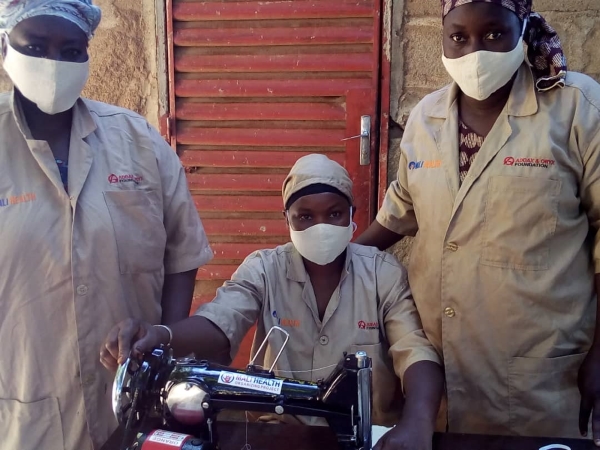
As the threat of COVID became clear, we decided to help women start sewing masks, using local cotton fabric. Our team quickly identified 30 women who already had basic sewing skills. We helped them to incorporate their cooperative and secure 5 sewing machines, along with the materials they would need. A very big thanks to Women International Leaders of Greater Philadelphia for the funds to purchase the equipment and materials.
The cooperative got started quickly and set the prices of adult masks at about $2 (1000 FCFA) and child masks at about $1 (600 FCFA). Mali Health was one of their first order; we purchased more masks for the staff at our CSCom partners in Bamako and Sikasso. As with the other cooperatives we have supported, the sewing cooperative not only provides much-needed revenue to families during the pandemic, they are also making very valuable resources available and accessible to peri-urban communities were resources are extremely limited.
We are even taking steps forward in helping the women who will lead a new union to support the cooperatives. In collaboration with the Direction Régionale du Développement Social et de l’Economie Solidaire du District de Bamako, women will receive training in leadership and management skills to help them develop and lead a resource of their own. Creating an association allows them to support and grow their cooperatives, while helping more women in peri-urban communities to launch cooperatives of their own. Stay tuned for more details!